
EDUCATION
From the mid-19th c., thanks to the Jewish Theological Seminary, Breslau was a world center for Jewish higher religious education, attracting students and professors from across Germany and abroad. As for elementary and secondary education, children attended schools with various profiles: secular, religious, state-run, and those operated by Jewish foundations. Secular schools, in particular, gained popularity with the increasing presence of Jews in public, economic and scientific life. In the early 20th c., broader educational opportunities opened up for girls when they were admitted to secondary schools, hitherto reserved for boys.
-

Bertha Hadda’s (née Simlinger) teacher’s certificate, 1916.
documentMore about objectIn 1916, 21-year-old Berta Simlinger passed her vocational exams to become a teacher of handicrafts in girls’ schools. This achievement marked the completion of her training at the State Academy of Fine and Applied Arts in Breslau. In this photo from 1911, she is pictured among her fellow students sitting next to her future husband […]
-

Berta Hadda with colleagues, 1911.
photographMore about objectIn 1916, 21-year-old Berta Simlinger passed her vocational exams to become a teacher of handicrafts in girls’ schools. This achievement marked the completion of her training at the State Academy of Fine and Applied Arts in Breslau. In this photo from 1911, she is pictured among her fellow students sitting next to her future husband […]
-

Berta Hadda’s Kilim, 1930s.
3D model, objectMore about objectThe modernist auditorium designed by Albert Hadda in the attic of the Jewish school at Rehdigerplatz 3 (57 Żelazna Street), was inaugurated in January 1938. It was to be the last major building project in the school. Established in 1920, the school housed a synagogue and a kosher canteen. Despite its traditionalism, the school embraced […]
-

The garden of the Jewish school, ca. 1938.
photographMore about objectThe modernist auditorium designed by Albert Hadda in the attic of the Jewish school at Rehdigerplatz 3 (57 Żelazna Street), was inaugurated in January 1938. It was to be the last major building project in the school. Established in 1920, the school housed a synagogue and a kosher canteen. Despite its traditionalism, the school embraced […]
-
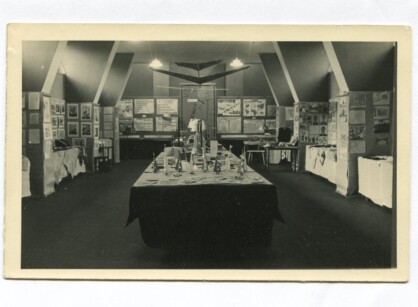
New auditorium at the attic of the Jewish school on Rehdigerplatz (57 Żelazna Street), Breslau, 1938.
photographMore about objectThe modernist auditorium designed by Albert Hadda in the attic of the Jewish school at Rehdigerplatz 3 (57 Żelazna Street), was inaugurated in January 1938. It was to be the last major building project in the school. Established in 1920, the school housed a synagogue and a kosher canteen. Despite its traditionalism, the school embraced […]
-

Elementary School report card for Erwin Zadik, 1920.
documentMore about objectThe school certificate of eight-year-old Erwin Zadik shows that he completed the second grade at the public Kaiser Wilhelm School at Paradiesstraße 3-5 (Stanisława Worcella Street) and was considered diligent and attentive in class. As a Jewish student, he did not receive a grade in religion, a class offered exclusively for Protestants and Catholics. The […]
-
Heinrich Tischler’s art class students, 1937/1938.
artworkMore about objectIn this sketch, artist Heinrich Tischler depicted his students during drawing classes that he taught among others at the Jewish high school affiliated with the New Synagogue in Breslau. The school, established in 1933 during Nazi repression of Jews, provided education to Jewish students expelled by the authorities from public schools. For Tischler, deprived by […]
-

Willy Cohn with his students and the school principal in the Johannes Gymnasium in Breslau, 1931.
photographMore about objectFinal exams were an important event in the life of a school. This photo of the 1931 graduating class of the public Johannes-Gymnasium, or St. John’s High School, at Paradiesstraße 3 (Stanisława Worcella Street) was probably taken on such an occasion. Visible in the background is Professor Willy Cohn, a history teacher at the school. […]
-

Illustration featuring the building of the Jewish Theological Seminary in Breslau, 1915.
documentMore about objectThe diploma honoring the lawyer and politician Wilhelm Salomon Freund features the building of the Jewish Theological Seminary in Breslau. The institution, founded in 1854, was located at Wallstraße 14 (Pawła Włodkowica Street) and trained students to become rabbis and teachers, providing a comprehensive curriculum that integrated religious and secular courses. For more than 80 […]