
List of
objects
-

The story of Alfred Neuländer’s prayer book
The story of Alfred Neuländer’s prayer book told by his nephew Oliver Newland, New Zealand. Language versions: EN Photos: Fundacja Spark
-

The story of Willy Cohn’s diaries
The story of Willy Cohn’s diaries told by his granddaughter Tamar Cohn Gazit, Israel. Language versions: EN HEB
-

The story of Berta Hadda’s kilim
The story of Berta Hadda’s kilim told by her great-grandson Daniel Ljunggren, Sweden. Language versions: EN SE TIMELINE 1936: Tapestry is created at the Jewish school in Breslau – a collaborative work by Berta Hadda and her pupils. Breslau, Germany 1940s: Tapestry is handed over together with clothes and other belongings to Berta’s brother […]
-

Testimony by Gabrielle Falk, née Freund
Testimony by Gabrielle Falk, née Freund (1923 – 2019) about her early life in Breslau before emigration (segment of a US-made podcast documentary on the Falk Family by Rosa Linda Ramon, 2009).
-

“Reverse Motion” by Anna Schapiro
Ink on wall, ink on paper, 2024. The exhibition was accompanied by a site-specific artistic commentary by Anna Schapiro. Schapiro, a Berlin based artist, explored the layers of histories encapsulated in the objects presented at the exhibition, the cumulative stories they conveyed and the way these invisible and neglected pasts still weave themselves into the […]
-

Deregistration of the Herz family from their house, September 1, 1939.
For Walter, Hilde and Steffi Herz, this compulsory police document of “deregistration” from their apartment at Straße der SA 54 (before 1933 Kaiser-Wilhelmstraße, now Powstańców Śląskich Street) marked the definitive closure of matters before emigration. The letter indicated the destination of their departure: Santiago de Chile. Approximately 13,500 Breslau Jews filed similar documents and dispersed […]
-

Table and chairs made by Albert Hadda, 1936.
Some families fled with very little luggage, while others took all their belongings and items they had specially ordered for a life in exile. Among them was this table with chairs, the most practical of furniture and universal symbols of home. They were made by the architect and designer Albert Hadda in 1936 for the […]
-
Steffi Herz, her mother Hilde, Grandmother Gertrud Bornstein and great grandmother Henriette Lomniz, ca. 1939.
Only a year after leaving Germany, Hilde and Walter Herz managed to bring Hilde’s mother, Gertrud Bornstein, to Chile. In this photo taken in Breslau while the family was still together, Gertrud sits on the left, accompanied by her mother, daughter, and granddaughter. Walter’s mother, Olga Herz, also hoped to leave Germany, as she wrote […]
-
Letter of recommendation for Steffi Herz, July 31, 1939.
The destruction of the shoe store and the escalating Nazi terror motivated Walter and Hilde Herz to leave Germany for Chile where Hilde’s brother had settled. At the Jewish school that their daughter Steffi attended, they applied for a letter of recommendation to facilitate her enrollment in a school abroad. In the letter, the teacher […]
-
Fragment from a newspaper „Breslauer Jüdisches Gemeindeblatt”, 1938.
“Shoes for emigrants” – with this slogan, the Herz shoe store advertised its product range in the press in October 1938. It was aimed at Jews fleeing en masse from Germany to escape persecution, which did not spare the Herz family themselves. In the pogrom of November 9–10, 1938, the Nazis in Breslau vandalized about […]
-

Poems by Willy Cohn, 1910.
“It was very painful for me to say goodbye to Daniel,” Willy Cohn noted in his journal on February 17, 1939. He was referring to Rudolf Daniel, his friend and former student, who was granted permission to immigrate to Mandatory Palestine, where he secured a position at a high school in Haifa and later at […]
-

Breslau Pharus Plan 1939.
Since its opening in 1872, the New Synagogue was often marked on Breslau city maps with an icon or a color reserved for prominent and recognizable landmarks. However, in the 1939 city plan, the New Synagogue is no longer present. All that was left of the building, demolished a year earlier by the Nazis during […]
-

In 1937 Willy Cohn and his wife Trudi spent a month in Mandatory Palestine in hopes of finding employment that would allow them to leave Germany permanently. This photo was taken during his stay at Kibbutz Givat Brenner where his son Ernst Abraham was already residing.
The number of Jews desperate to leave Germany after the November Pogrom surged, but they found few countries willing to take them in. In Mandatory Palestine, British quotas, issued every six months, limited the number of Jewish immigrants. Preference was given to young applicants who were fit for agricultural work. In 1935, fifteen-year-old Ernst Abraham […]
-
From the left Ruth, Tamara and Susanne Cohn, September 1939.
The number of Jews desperate to leave Germany after the November Pogrom surged, but they found few countries willing to take them in. In Mandatory Palestine, British quotas, issued every six months, limited the number of Jewish immigrants. Preference was given to young applicants who were fit for agricultural work. In 1935, fifteen-year-old Ernst Abraham […]
-
Heinrich Tischler’s self-portrait, 1937.
Living under constant threat led to anxiety, frustration and depression. The artist Heinrich Tischler illustrated his emotional and spiritual crisis in this self-portrait, in which he depicted himself as a “living dead” spirit, clenching his fists in a gesture of helplessness. Due to Nazi persecution, Tischler, like many Jewish artists, had to abandon his work […]
-

Cohn siblings, 1935. From the left Ruth, Ernst Abraham and Susanne.
The number of Jews desperate to leave Germany after the November Pogrom surged, but they found few countries willing to take them in. In Mandatory Palestine, British quotas, issued every six months, limited the number of Jewish immigrants. Preference was given to young applicants who were fit for agricultural work. In 1935, fifteen-year-old Ernst Abraham […]
-

Erwin Zadik’s passport, 1937.
The Gestapo also persecuted Erwin Zadik, Ursula Beyer’s husband. After Erwin’s deportation to the Buchenwald concentration camp just two months after their wedding, Ursula purchased steamboat tickets for them to leave Germany as quickly as possible. Their destination was the British-American International Settlement in Shanghai, the only place in the world granting asylum to Jewish […]
-

Envelope of a letter written by Ursula Zadik from the prison in Breslau, January 5, 1939.
The Gestapo, the secret police, arrested Helga and Ursula Beyer in 1938 and held them in jail from where the sisters sent letters to their loved ones in envelopes like this one. The court acquitted Ursula, but sentenced Helga to three and a half years in prison for high treason as a communist who allegedly […]
-

Ursula and Helga Bayer with friends, Sudeten Mountains, 1937.
In Nazi Germany, political opposition was illegal, and cooperation with underground resistance groups required courage that few could muster. Sisters Ursula and Helga Beyer had that courage. One of the sisters’ tasks was to smuggle anti-Nazi newspapers from Czechoslovakia to Germany in ski poles under the guise of skiing expeditions in the Sudeten Mountains. In […]
-
Heinrich Tischler’s postcard from Buchenwald concentration camp, 1938.
On November 12, 1938, the planned tasks in Heinrich Tischler’s calendar abruptly end. On that day, as part of an operation to arrest Jewish men throughout Germany, the Nazis deported him to the Buchenwald concentration camp. “I’m doing well here, I don’t need anything,” he wrote on a postcard sent from the camp to his […]
-
Heinrich Tischler’s pocket calendar, 1938.
On November 12, 1938, the planned tasks in Heinrich Tischler’s calendar abruptly end. On that day, as part of an operation to arrest Jewish men throughout Germany, the Nazis deported him to the Buchenwald concentration camp. “I’m doing well here, I don’t need anything,” he wrote on a postcard sent from the camp to his […]
-

Halperts’ Chanukah, December 25, 1938.
On December 25, 1938, in the home that lawyer Otto Halpert shared with his wife Hertha and their three daughters at Eichendorffstraẞe 32/34 (Sokola Street), the eighth candle was lit on the traditional candelabrum known as the hanukkiah to mark the last day of the holiday of Hanukkah. One of the family members took this […]
-
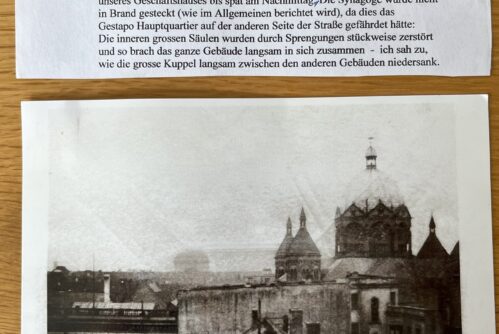
New Synagogue in Breslau, nd.
On the night of November 9–10, 1938, Nazi paramilitaries, inspired by the authorities, carried out a pogrom against Jews throughout Germany, beating and killing people, vandalizing their houses and stores, and destroying synagogues. Hans Hermann Neustadt witnessed the destruction of the New Synagogue in Breslau. He kept this photograph of the Synagogue’s dome and towers […]
-

Albert Haddy’s application to the State Board of Fine Arts to revoke the exclusion decision, 1934.
In November 1934, Albert Hadda, like all Jewish architects in Germany, received a letter from the State Chamber of Fine Arts informing him that he was banned from practicing his profession. Albert decided to fight back: he submitted an appeal, but it was unsuccessful, and he was forced to find another source of income. Commissioned […]
-

Albert Hadda’s Arbeitbuch, 1936.
In November 1934, Albert Hadda, like all Jewish architects in Germany, received a letter from the State Chamber of Fine Arts informing him that he was banned from practicing his profession. Albert decided to fight back: he submitted an appeal, but it was unsuccessful, and he was forced to find another source of income. Commissioned […]
-

Willy Cohn in his study in 1934, in his home at 28 Opitz Street (Żelazna Street), Breslau, August 1934.
“Stephan, the school janitor, brought me a letter stating that I am on leave with immediate effect,” Willy Cohn, a historian and teacher at the Johannes-Gymnasium, noted in his journal on June 18, 1933. Already in the first months after coming to power, the Nazis used dismissals, forced leaves and early retirements against Jewish teachers, […]
-

Birthday letter in envelope to Steffi Herz in Chile from grandmother Olga in Breslau, March 15, 1940.
Only a year after leaving Germany, Hilde and Walter Herz managed to bring Hilde’s mother, Gertrud Bornstein, to Chile. In this photo taken in Breslau while the family was still together, Gertrud sits on the left, accompanied by her mother, daughter, and granddaughter. Walter’s mother, Olga Herz, also hoped to leave Germany, as she wrote […]
-

Ice skaters in Breslau, winter 1940/1941.
This photo of ice skaters on the frozen moat that runs along Wallstraße (Pawła Włodkowica Street) was taken in the winter of 1940-41 by Albert Hadda from the window of his apartment in Nikolai Stadtgraben 16 (Podwale Street). Was the photograph just a practice shot to test a new camera, or maybe an expression of […]
-
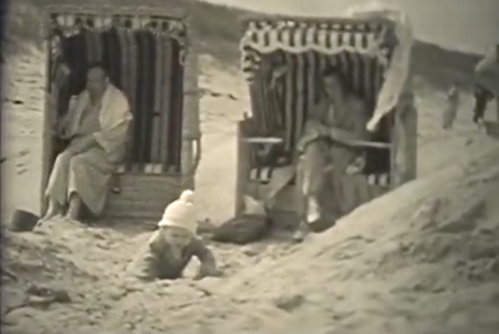
In the shadow of swastikas on the Baltic Sea, video, 1930s.
In the 1930s, the adopted family of pharmacologist Hermann Freund brought along an amateur camera on vacation, capturing shared moments on a Baltic beach. In the background of the cheerful shots, swastika pennants sometimes appear – the omnipresent symbols of the oppressive Nazi regime. Yet, despite difficulties, the majority of the Jews tried to live […]
-

Bertha Hadda’s (née Simlinger) teacher’s certificate, 1916.
In 1916, 21-year-old Berta Simlinger passed her vocational exams to become a teacher of handicrafts in girls’ schools. This achievement marked the completion of her training at the State Academy of Fine and Applied Arts in Breslau. In this photo from 1911, she is pictured among her fellow students sitting next to her future husband […]
-
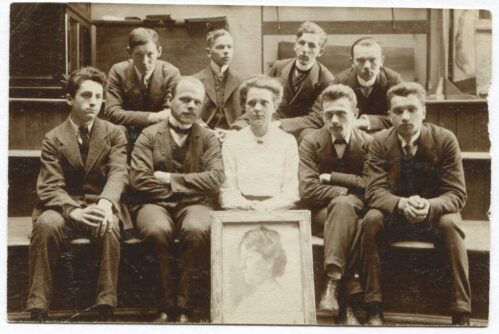
Berta Hadda with colleagues, 1911.
In 1916, 21-year-old Berta Simlinger passed her vocational exams to become a teacher of handicrafts in girls’ schools. This achievement marked the completion of her training at the State Academy of Fine and Applied Arts in Breslau. In this photo from 1911, she is pictured among her fellow students sitting next to her future husband […]
-
Berta Hadda’s Kilim, 1930s.
The modernist auditorium designed by Albert Hadda in the attic of the Jewish school at Rehdigerplatz 3 (57 Żelazna Street), was inaugurated in January 1938. It was to be the last major building project in the school. Established in 1920, the school housed a synagogue and a kosher canteen. Despite its traditionalism, the school embraced […]
-

The garden of the Jewish school, ca. 1938.
The modernist auditorium designed by Albert Hadda in the attic of the Jewish school at Rehdigerplatz 3 (57 Żelazna Street), was inaugurated in January 1938. It was to be the last major building project in the school. Established in 1920, the school housed a synagogue and a kosher canteen. Despite its traditionalism, the school embraced […]
-

New auditorium at the attic of the Jewish school on Rehdigerplatz (57 Żelazna Street), Breslau, 1938.
The modernist auditorium designed by Albert Hadda in the attic of the Jewish school at Rehdigerplatz 3 (57 Żelazna Street), was inaugurated in January 1938. It was to be the last major building project in the school. Established in 1920, the school housed a synagogue and a kosher canteen. Despite its traditionalism, the school embraced […]
-

Elementary School report card for Erwin Zadik, 1920.
The school certificate of eight-year-old Erwin Zadik shows that he completed the second grade at the public Kaiser Wilhelm School at Paradiesstraße 3-5 (Stanisława Worcella Street) and was considered diligent and attentive in class. As a Jewish student, he did not receive a grade in religion, a class offered exclusively for Protestants and Catholics. The […]
-
Heinrich Tischler’s art class students, 1937/1938.
In this sketch, artist Heinrich Tischler depicted his students during drawing classes that he taught among others at the Jewish high school affiliated with the New Synagogue in Breslau. The school, established in 1933 during Nazi repression of Jews, provided education to Jewish students expelled by the authorities from public schools. For Tischler, deprived by […]
-

Willy Cohn with his students and the school principal in the Johannes Gymnasium in Breslau, 1931.
Final exams were an important event in the life of a school. This photo of the 1931 graduating class of the public Johannes-Gymnasium, or St. John’s High School, at Paradiesstraße 3 (Stanisława Worcella Street) was probably taken on such an occasion. Visible in the background is Professor Willy Cohn, a history teacher at the school. […]
-

Illustration featuring the building of the Jewish Theological Seminary in Breslau, 1915.
The diploma honoring the lawyer and politician Wilhelm Salomon Freund features the building of the Jewish Theological Seminary in Breslau. The institution, founded in 1854, was located at Wallstraße 14 (Pawła Włodkowica Street) and trained students to become rabbis and teachers, providing a comprehensive curriculum that integrated religious and secular courses. For more than 80 […]
-
Heinrich Tischler, Self-portrait, 1937.
Heinrich Tischler, a painter and architect who graduated from the Academy of Fine Arts in Breslau, was a representative of Jewish Expressionism. He created emotional scenes depicting Jews immersed in fervent prayer, as well as surreal scenes of the suburbs of Breslau. In numerous self-portraits, he depicted himself with an ironic expression and a cigarillo […]
-
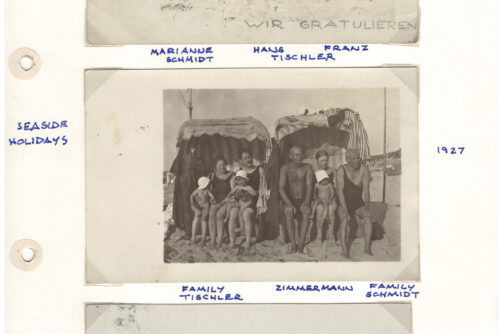
Photographs from holidays, sports activities and parties, before 1938.
“A vacationer at that time wanted nothing more than to inhale the scent of pine and wander,” wrote historian Willy Cohn in his journal. The Tischler family chose the Giant Mountains, not far from Breslau, as their vacation spot, but also the Austrian Alps and the beaches at Lake Müritz in Mecklenburg. Many Jews, especially […]
-
Heinrich Tischler, Portrait of Else Tischler, 1937.
Else Tischler, Heinrich Tischler’s wife, came from the Hadda family of artists. She had known her cousin Heinrich since childhood. She accompanied her husband both in life and in his career, and was his confidante, with whom he shared his artistic inspirations and dilemmas. After Heinrich’s death in 1938, Else, along with her sons Franz […]
-

String quartet with Walther Freund, early 20th c.
For pediatrician Walther Freund, amateur performances in a string quartet were probably both entertainment and an opportunity to develop his musical talent. He inherited his love of the viola from his father, Wilhelm Salomon Freund. Walther also enjoyed performing at home with his children – Andreas, who played the violin, and Gabrielle, who played the […]
-

Traveling chess set of Heinz Josef Foerder. nd.
Heinz Josef Foerder, who represented Germany at the 1928 Chess Olympiad in The Hague, took his first steps as a chess player in Breslau. In 1934, Foerder emigrated to Mandatory Palestine, where he achieved further victories. Upon the proclamation of the state of Israel, he changed his name to Yosef Porath. He died in 1996. […]
-

Nameplate from the flat of Heinrich Tischler, before 1938.
This brass nameplate with the embossed signature of Heinrich Tischler probably hung on the door of his apartment at the no longer existing Lothringer Straße 9 (in the vicinity of today’s Ostra Street). His studio was also located there. The artist used the same signature for his paintings, prints, and architectural designs.
-
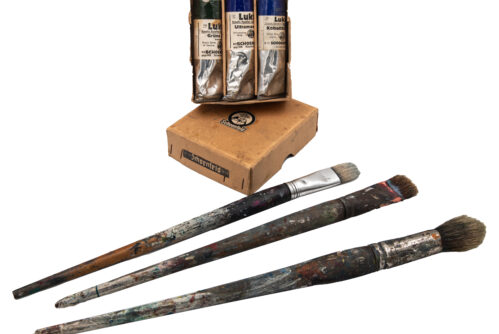
Brushes and paint tubes by Lukas manufacture, 1930s.
Fleeing Breslau, Else Tischler took her husband Heinrich’s painting tools from his studio. Among them were eight boxes of Lukas brand paints, a company which still exists today. The painter used the intense color palette seen here: sienna, ochre, intense yellow and orange, ultramarine and sea green.
-

Cigarillo box, first half of the 20th c.
Heinrich Tischler, a painter and architect who graduated from the Academy of Fine Arts in Breslau, was a representative of Jewish Expressionism. He created emotional scenes depicting Jews immersed in fervent prayer, as well as surreal scenes of the suburbs of Breslau. In numerous self-portraits, he depicted himself with an ironic expression and a cigar […]
-

Verein Jüdisches Museum E.V. zu Breslau, 1928.
The first exhibition of the Jewish Museum Association in Breslau, dedicated to Jews in the history of Silesia, was held in 1929 in the rooms of the Silesian Museum of Artistic Crafts and Antiquities. The exhibition was intended for a wide, not exclusively Jewish, audience, and some exhibits were reproduced in the Association’s bulletin. The […]
-

Rysunki architektoniczne Tischlera
Heinrich Tischler, Architectural perspectives (probably not realised), reproduction, undated.
-

Etrog box, beginning of the 20th c.
An etrog box is used during Sukkot, the holiday which commemorates the Jews living in huts as they fled from Egypt. Benno Sklarz, the owner of a kosher dairy store in Breslau, crafted this box which his son, Salo, took with him when he fled with his family from Breslau to London in 1939. His […]
-
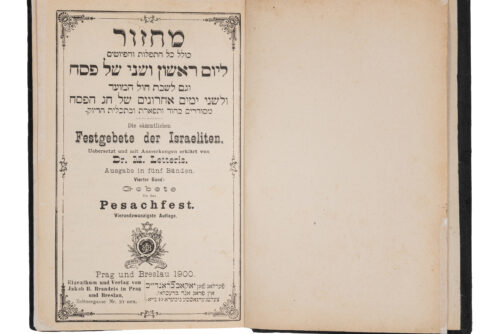
Die sämtlichen Festgebete der Israeliten: Gebete für das Pesachfest (with translation and commentary by Dr. M. Letteris), Prag and Breslau 1900.
Pesach is a holiday celebrated each spring to commemorate the biblical liberation of the Jews from Egyptian slavery. This bilingual Hebrew-German prayer book for Pesach belonged to the Zadik Family and was published in 1900 by the Jakob Berman Brandeis publishing house with its headquarters in Breslau and Prague. From the second half of the […]
-

Besamim (spice box), 19th c.
This besamim box, a container for fragrant spices and herbs used at the end of the weekly Shabbat celebration, originally belonged to Emanuel Falk, whose bar mitzvah speech was showcased earlier. One of his descendants, Siegfried Falk, emigrated from Breslau in 1936 and took the box with him, first to Copenhagen, then to London, and […]
-

Bat mitzvah photo of Hilde Bornstein (later Herz), 1919.
With the development of liberal Reform Judaism, girls could also celebrate the ceremony of entering adulthood known as bat mitzvah. In this photo, fifteen-year-old Hilde Bornstein poses with her friends and the rabbi who prepared them for the ceremony. Three years later, Hilde would marry Walter Herz, and together they would run a shoe store […]
-

Tefillin set, beginning of the 20th c.
Tefillin is a set of two boxes, each with connected leather straps containing parchment scrolls with Torah verses pertaining to ritual commandments. Orthodox men tie one box to their forehead and the other to their left arm, wrapping the connected leather strap around the lower arm and hand for daily prayers. This tefillin set, which […]
-

Watch – bar mitzvah gift for Hans Falk, 1932.
Secular customs, such as holding parties and bringing gifts to the bar mitzvah boy, were increasingly permeating celebrations of this religious tradition. A coveted gift was a watch, like this one, which Hans Falk, grandson of Emanuel Falk, received for his bar mitzvah in 1932.
-

Bar mitzvah speech by Emanuel Falk, 1845.
“I now know my obligations to God, as well as to myself and my fellow men,” said Emanuel Falk during his bar mitzvah. It took place in 1845 at the Sklower Synagogue, a small prayer house located on the upper floor in the courtyard at Goldene Radegasse 2 (Kazimierza Wielkiego Street near the intersection with […]
-

Tallit set of Bruno Falk, 1894.
During a bar mitzvah, Jewish boys put on a special prayer outfit for the first time. One of its elements is the tallit, a shawl worn over the shoulders. Bruno Falk celebrated his bar mitzvah in 1894 and likely prayed in this tallit for the rest of his life. Stored in a small velvet bag, […]
-

Dedication card for the bar mitzvah of Alfred Neuländer, 1925.
The dedication card from Alfred Neuländer’s prayer book shows a scene of the passing down of religious law from generation to generation. In the background, the New Synagogue towers over Breslau. Built between 1865 and 1872, it served not only as a place of worship for the liberal faction of the Jewish community, but also […]
-

Israelitisches Gebetbuch für die öffentliche Andacht des ganzen Jahres, by Rabbi dr Manuel Joël, checked by prof. dr Jakob Guttmann, Rabbi of the Jewish Community, Breslau, 1897.
Thirteen-year-old Alfred Neuländer received this book containing prayers covering the liturgical year as a gift for his bar mitzvah, a ceremony marking the transition into adulthood and the assumption of religious responsibilities. The book includes commentaries by local liberal rabbis Manuel Joël and Jakob Guttmann. The New Synagogue, where Alfred’s ceremony took place, is depicted […]
-

Business correspondence (postcards) of Herz family from 1907 -1913
Ludwig Herz, and later his son Walter, did not limit their commercial affairs to the shoe store – they expanded their business worldwide. These trade connections are evident in numerous postcards containing orders for shoes from customers and dealers not only from Europe, but also the Americas, Asia, and German colonies in Africa. Many of […]
-

Storefront and logo of the Herz family shoe store, ca. 1930.
In 1894, merchant Ludwig Herz opened his shoe store in the Oppenheim House. The product range was aimed at wealthy customers, attracted not only by the high quality of shoes and accessories but also by Ludwig’s marketing skills. In advertisements and in the company logo, he played on his last name Herz, which means ‘heart’ […]
-

Symphonion sold by Bial & Freund, ca. 1900.
When in 1864 merchant Leopold Bial founded a bookstore in Breslau, he perhaps did not anticipate that the business would in time transition to a new but promising commercial model: mail-order sales. Leopold and his successors soon expanded their offerings and the catalog for Bial & Freund, their mail-order business headquartered at Taunetzienstraße 16 (Tadeusza […]
-

Owners and employees of the furniture factory of Hadda brothers and Heinrich Tischler, ca. 1918. In the second row of people standing, third from the left, Heinrich Tischler, then Willy and Albert Hadda.
In 1918, as World War I was coming to an end and life was slowly returning to normal, the employees and owners of a furniture factory posed for a group photo. The factory belonged to brothers Willy and Albert Hadda, and their cousin and brother-in-law Heinrich Tischler. The Haddas and Heinrich Tischler would continue to […]
-

Bial & Freund’s mail-order catalog, c. 1910.
When in 1864 merchant Leopold Bial founded a bookstore in Breslau, he perhaps did not anticipate that the business would in time transition to a new but promising commercial model: mail-order sales. Leopold and his successors soon expanded their offerings and the catalog for Bial & Freund, their mail-order business headquartered at Taunetzienstraße 16 (Tadeusza […]
-

Brockhaus Encyclopedia, 1893.
When in 1864 merchant Leopold Bial founded a bookstore in Breslau, he perhaps did not anticipate that the business would in time transition to a new but promising commercial model: mail-order sales. Leopold and his successors soon expanded their offerings and the catalog for Bial & Freund, their mail-order business headquartered at Taunetzienstraße 16 (Tadeusza […]
-

Sklarz family kosher store by Antonienstraße (Św. Antoniego Street), beginning of the 20th c.
“Kosher” and “Sale of milk, butter, and cheese under the supervision of the rabbinate” – these inscriptions in Hebrew and German on the storefront informed Jewish customers about the offerings of Benno Sklarz’s store on Antonienstraße (św. Antoniego Street). The dairy products sold there were kosher, indicating that they were produced and stored in accordance […]
-

Hadda brothers (from the left) Willi, Sigmund, Albert i Moritz, November 1916.
The Hadda brothers pose together for a photo that dates back to their service in the German army during World War I. Already then, their interests and career plans led each of them in different directions. The eldest, Siegmund, became a surgeon and the head of the Jewish hospital in Breslau; Moritz and Albert pursued […]
-

Photographic postcard from the First World War front sent by Felix Peritz, December 31, 1915.
When World War I broke out in 1914, Jews were also drafted into the German army, and among them was 25-year-old Felix Peritz. His grandson Joseph Pearce recalls that Felix went to war as if it were an adventure and was proud of his service as a non-commissioned medical officer. He sent this photo picturing […]
-

Lorgnon of Else Peritz, ca. 1920.
What theatrical or opera performances did Else Peritz enjoy using these opera glasses? Her passion for art and her refined tastes were cultivated in her family home: one of her nephews was a composer; an uncle was a pianist and a choir conductor; and her niece was an opera singer at the Breslau Stadttheater.
-

Coffee cup with dedication for Else Peritz, 1921
“For my beloved daughter-in-law, Else,” reads the dedication on this cup that Mathilde Peritz presented to her daughter-in-law Else, née Durra. The gesture speaks of warmth, despite the difference in worldviews, between the two families: the Peritz family was conservative, while the Durra family was liberal. For Mathilde’s son, Felix, the progressiveness of his wife […]
-

Frying pan and a wooden spoon of Ursula and Helga Beyer, around 1925.
Ursula Beyer and her two-years-younger sister Helga grew up in an interfaith family. Their father, Adolf, was Jewish and their mother, Else, although born to Christian parents, was an atheist. When the girls were 13 and 11, the peaceful childhood was disrupted by Else’s death. Ursula remembered how their widowed father made scrambled eggs for […]
-

Photo of sisters Ursula and Helga Beyer, 1920s.
Ursula Beyer and her two-years-younger sister Helga grew up in an interfaith family. Their father, Adolf, was Jewish and their mother, Else, although born to Christian parents, was an atheist. When the girls were 13 and 11, the peaceful childhood was disrupted by Else’s death. Ursula remembered how their widowed father made scrambled eggs for […]
-

Gabrielle Freund (later Falk) in the house by Vogelweide 187 (19 Mikołaja Kopernika Street), 1933.
Little Gabrielle Freund reads a book in a room filled with toys. However, toys were not the only objects surrounding her during her childhood. Gabrielle also grew up among mementos of her ancestors. Her father, pediatrician Walther Freund, kept portraits of, among others, her grandfather Wilhelm Salomon Freund, a city councilman, and her great-grandmother Babette […]
-
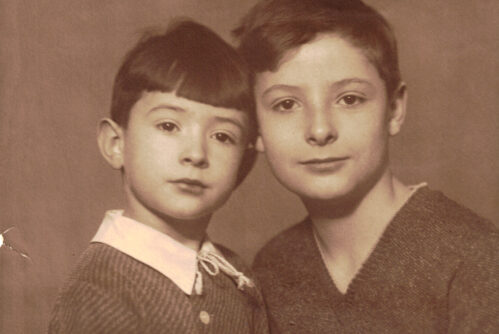
Photo of brothers Werner and Ernst Peritz, 1933.
The initials engraved on each of the items point to their owners: the egg cup belonged to young Werner Peritz, and the hairbrush to his younger brother Ernst. Their parents, Else and Felix Peritz, gave their sons typical German names as a way of expressing their attachment to German culture. Just two generations earlier, most […]
-

The egg cup of Werner Peritz, 1920.
The initials engraved on each of the items point to their owners: the egg cup belonged to young Werner Peritz, and the hairbrush to his younger brother Ernst. Their parents, Else and Felix Peritz, gave their sons typical German names as a way of expressing their attachment to German culture. Just two generations earlier, most […]
-
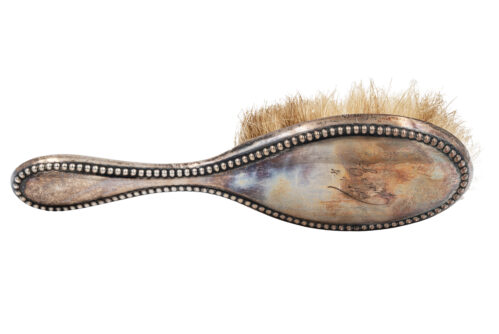
The hairbrush of Ernst Peritz, date of his birth, July 4, 1928.
The initials engraved on each of the items point to their owners: the egg cup belonged to young Werner Peritz, and the hairbrush to his younger brother Ernst. Their parents, Else and Felix Peritz, gave their sons typical German names as a way of expressing their attachment to German culture. Just two generations earlier, most […]
-

Heinrich Tischler, congratulations card on the birth of Ruth Hadda, 1921.
When Berta and Albert Hadda’s first child – a daughter named Ruth Elizabeth – was born in November 1921, they received many congratulations from family and friends. The young parents decided to express their gratitude by sending special thank-you cards. They bore the portrait of little Ruth drawn by artist Heinrich Tischler, Albert’s cousin.
-

Martha Graetzer and Gregor Henze, 2022.
In 1892, Wilhelm Salomon Freund and his wife Clara celebrated their twenty-fifth wedding anniversary. During the celebrations, Clara wore a silver tiara and brooch. They thus initiated a tradition that has survived among their descendants in the United States, with slight modification, to this day: on the tenth and twenty-fifth wedding anniversaries, the ladies still […]
-

Bill Fabbri and Ann Goebel-Fabbri, 2021.
In 1892, Wilhelm Salomon Freund and his wife Clara celebrated their twenty-fifth wedding anniversary. During the celebrations, Clara wore a silver tiara and brooch. They thus initiated a tradition that has survived among their descendants in the United States, with slight modification, to this day: on the tenth and twenty-fifth wedding anniversaries, the ladies still […]
-

Laura and Jay Snabel, 2022.
In 1892, Wilhelm Salomon Freund and his wife Clara celebrated their twenty-fifth wedding anniversary. During the celebrations, Clara wore a silver tiara and brooch. They thus initiated a tradition that has survived among their descendants in the United States, with slight modification, to this day: on the tenth and twenty-fifth wedding anniversaries, the ladies still […]
-

Stephen Falk and Liz Otwell, 2010.
In 1892, Wilhelm Salomon Freund and his wife Clara celebrated their twenty-fifth wedding anniversary. During the celebrations, Clara wore a silver tiara and brooch. They thus initiated a tradition that has survived among their descendants in the United States, with slight modification, to this day: on the tenth and twenty-fifth wedding anniversaries, the ladies still […]
-

Elisabeth and Rudolf Freund, 1947.
In 1892, Wilhelm Salomon Freund and his wife Clara celebrated their twenty-fifth wedding anniversary. During the celebrations, Clara wore a silver tiara and brooch. They thus initiated a tradition that has survived among their descendants in the United States, with slight modification, to this day: on the tenth and twenty-fifth wedding anniversaries, the ladies still […]
-

Silver tiara and pin of Freund and Falk family, 1892.
In 1892, Wilhelm Salomon Freund and his wife Clara celebrated their twenty-fifth wedding anniversary. During the celebrations, Clara wore a silver tiara and brooch. They thus initiated a tradition that has survived among their descendants in the United States, with slight modification, to this day: on the tenth and twenty-fifth wedding anniversaries, the ladies still […]
-

Menu for the wedding of Hilde Bornstein and Walter Herz, 1922.
Crayfish soup, marinated eel, veal fillet, goose, Pückler’s Bombe ice cream, and mini cheesecakes – these specialties were included in the wedding menu of Hilde Bornstein and Walter Herz. Some dishes, such as crayfish and eel, were not kosher, meaning that Jewish religious law prohibits their consumption. The newlyweds and their guests, however, did not […]
-

Wedding photo of Ursula Beyer and Erwin Zadik, September 8, 1938.
After a 9-month-long engagement, Ursula Beyer, called Ursel by her friends and family, and Erwin Zadik married in September 1938. The wedding took place in the White Stork Synagogue. Erwin came from a much more religious family than Ursula. After the ceremony, the bride and groom posed for a photo on the balcony of the […]
-

Ursula Beyer and Erwin Zadik engagement announcement, 1938.
After a 9-month-long engagement, Ursula Beyer, called Ursel by her friends and family, and Erwin Zadik married in September 1938. The wedding took place in the White Stork Synagogue. Erwin came from a much more religious family than Ursula. After the ceremony, the bride and groom posed for a photo on the balcony of the […]
-
Family Tischler and Hadda, 1936.
In October 1936, 13-year-old Franz Tischler had his bar mitzvah – a ceremony that formally marks the transition from boyhood to manhood, signifying the moment when the young individual assumes responsibility for his actions in accordance with Jewish religious law. It was an opportunity for two related families, the Tischlers and Haddas, to celebrate together. […]
-

Blücherplatz 4 u. 5 zu Breslau, vor der Bereinigung der Gebäudefront.
Jews were residents of the Oppenheim House since the early 19th c. In 1810, banker Heymann Oppenheim purchased the building and moved in with his family. The Oppenheims were among the so-called privileged Jews, who had a permit for permanent settlement in the city. From 1902 to 1942, the building belonged to the Jewish community, […]
-

Four generations of women from Herz family: Steffi Herz, her mother Hilde, grandmother Gertrud Bornstein and great grandmother Henriette Lomnitz, 1929.
From 1894, for over 40 years, the Herz family ran a shoe store in the Oppenheim House at Blücherplatz 4 (Salt Square), where we are currently standing. This photo, with the now non-existent south wing of the Royal Palace at Schloßplatz (Wolności Square) visible in the background, depicts the female representatives of four generations of […]
-
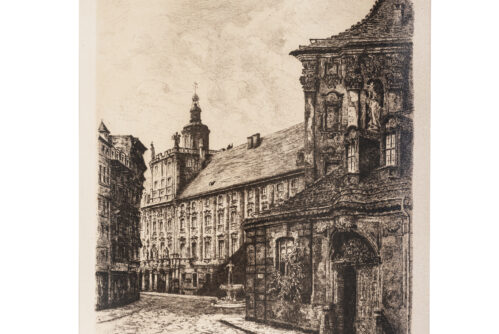
H. Fischer, etching with the view of the University in Breslau, after 1904.
The apartment of doctor Walther Freund was decorated with a bronze figure of a fencer – a miniature of the sculpture from the fountain found in the front of the University of Breslau, dating back to 1904. Perhaps the iconic figure reminded Walther of his days as a student: both he and his father Wilhelm […]
-

Photo of the interior of the house by Vogelweide 187 (19 Mikołaja Kopernika Street), 1933.
The apartment of doctor Walther Freund was decorated with a bronze figure of a fencer – a miniature of the sculpture from the fountain found in the front of the University of Breslau, dating back to 1904. Perhaps the iconic figure reminded Walther of his days as a student: both he and his father Wilhelm […]
-
Diploma on the occasion of Wilhelm Salomon Freund’s retirement from the position of the Chairman of Council, December 29th, 1914.
The end of Wilhelm Salomon Freund’s municipal duties coincided with the beginning of World War I. Influenced by his conciliatory attitude, the German Progressive Party, of which he was a member, refrained from criticizing Kaiser Wilhelm II at the time. A year before his death, Freund received this diploma, decorated with a depiction of the […]
-
Diploma of honorary citizenship for Wilhelm Salomon Freund, the Secret Counselor, awarded to him by the city magistrate on January 1st, 1901.
“Arbeit ist des Bürgers Zierde” – “Work’s the burgher’s decoration”. This motto, taken from Friedrich Schiller’s poem, is featured on the “Ehrenbürgerurkunde”, or Certificate of Honorary Citizenship awarded to Wilhelm Salomon Freund in recognition of his decades of service as a longtime member and chairman of the Breslau City Council its. Freund was the first […]
-

Portrait photograph of Wilhelm Salomon Freund as a young man, 1860s.
Wilhelm Salomon Freund was a lawyer and president of the Breslau Bar Association. A distinguished graduate of the University of Breslau who defended his doctoral thesis at the age of twenty, he received an honorary doctorate from the law faculty in 1901. He is remembered by his family just like he is portrayed in this […]
-

Photo of the interior of the house by Vogelweide 187 (19 Mikołaja Kopernika Street), 1933.
Babette Silberstein’s portrait adorned successive residences of her descendants in Breslau, which included the home of her daughter Lina Immerwahr, née Silberstein, located at Ring 19 (Market Square 19). In the early 20th c., it hung in the home of her granddaughter Clara Freund, née Immerwahr, at Schweidnitzer Stadtgraben 20 (Podwale Street). By 1930, it […]
-

Portrait of Babette Silberstein, first half of the 19th century.
Breslau, the largest city and economic center of Silesia, attracted newcomers from smaller towns. Babette Silberstein, née Friedländer, arrived in Breslau with her husband Philipp from the town of Brieg (today Brzeg) around 1814. They settled at Wallstraße 13 (now Pawła Włodkowica Street), near to where the White Stork Synagogue, co-founded by Philipp, would soon […]
-

Descendants
Testimonies of contemporary members of the families presented at the exhibition about their relations with Breslau/Wrocław.
-

Mezuzah from the Oppenheim House, parchment, 19th-20th c.
A mezuzah is a scroll of parchment inscribed with passages from the Torah (Book of Deuteronomy), slipped into a case and affixed to the doorposts of a Jewish home. During the renovation of the building we are currently in, the Oppenheim House, from 2013 to 2017, two mezuzot were found: one in a damaged case […]
-

Piece of paper with text, 19th c.
The Oppenheim House holds untold stories that we are unable to fully reconstruct. Among the objects found here during the 2013–2017 renovation was this piece of paper, presumably ripped from a notebook. Researchers and paper conservators estimate that it dates back to the 19th c. It contains repeated Hebrew letters and a few words in […]