
RELIGION
The Emancipation Act of 1812 was a first, significant step toward the granting of equal civic rights to Jews in Prussia. In Breslau, this change in civic status gave impetus to further Jewish integration into mainstream society and led to modifications in religious practices and attitudes toward tradition. Rabbi Abraham Geiger, an influential religious leader in Breslau, started conducting prayers in German and not in Hebrew in 1843. Geiger’s progressive views on conducting liturgy in German, modernizing dietary laws, or abolishing circumcision found supporters. However, a long, deep divide emerged between the liberals headed by Geiger and the Orthodox current spearheaded by the Tiktin rabbinical family. Eventually, conservative and progressive groups in the Jewish community began to drift further apart and clustered around two separate synagogues, the White Stork Synagogue, which became the communal center of Orthodox Jews, and the imposing “New” Synagogue, completed in 1872. However, in a political sense, the community never formally split. Jewish historian Willy Cohn captured the nature of this division within the community as follows: “At the time, it was more of a difference between two brothers who may not express the same opinions, but that does not mean they are enemies.” The city became home of the influential Jewish Theological Seminary of Breslau, whose leader, Rabbi Zacharias Frankel, advocated a middle road for Jewish religiosity and is considered the founder of the Judaism’s Conservative movement.
-

Etrog box, beginning of the 20th c.
3D model, objectMore about objectAn etrog box is used during Sukkot, the holiday which commemorates the Jews living in huts as they fled from Egypt. Benno Sklarz, the owner of a kosher dairy store in Breslau, crafted this box which his son, Salo, took with him when he fled with his family from Breslau to London in 1939. His […]
-

Die sämtlichen Festgebete der Israeliten: Gebete für das Pesachfest (with translation and commentary by Dr. M. Letteris), Prag and Breslau 1900.
publicationMore about objectPesach is a holiday celebrated each spring to commemorate the biblical liberation of the Jews from Egyptian slavery. This bilingual Hebrew-German prayer book for Pesach belonged to the Zadik Family and was published in 1900 by the Jakob Berman Brandeis publishing house with its headquarters in Breslau and Prague. From the second half of the […]
-

Besamim (spice box), 19th c.
objectMore about objectThis besamim box, a container for fragrant spices and herbs used at the end of the weekly Shabbat celebration, originally belonged to Emanuel Falk, whose bar mitzvah speech was showcased earlier. One of his descendants, Siegfried Falk, emigrated from Breslau in 1936 and took the box with him, first to Copenhagen, then to London, and […]
-

Bat mitzvah photo of Hilde Bornstein (later Herz), 1919.
photographMore about objectWith the development of liberal Reform Judaism, girls could also celebrate the ceremony of entering adulthood known as bat mitzvah. In this photo, fifteen-year-old Hilde Bornstein poses with her friends and the rabbi who prepared them for the ceremony. Three years later, Hilde would marry Walter Herz, and together they would run a shoe store […]
-

Tefillin set, beginning of the 20th c.
objectMore about objectTefillin is a set of two boxes, each with connected leather straps containing parchment scrolls with Torah verses pertaining to ritual commandments. Orthodox men tie one box to their forehead and the other to their left arm, wrapping the connected leather strap around the lower arm and hand for daily prayers. This tefillin set, which […]
-
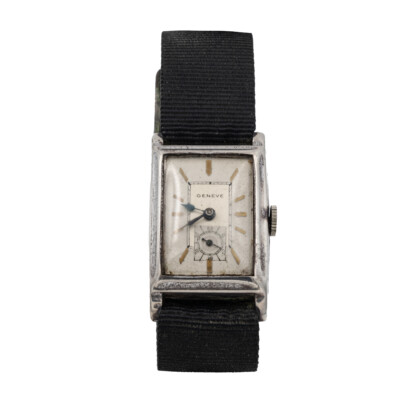
Watch – bar mitzvah gift for Hans Falk, 1932.
objectMore about objectSecular customs, such as holding parties and bringing gifts to the bar mitzvah boy, were increasingly permeating celebrations of this religious tradition. A coveted gift was a watch, like this one, which Hans Falk, grandson of Emanuel Falk, received for his bar mitzvah in 1932.
-

Bar mitzvah speech by Emanuel Falk, 1845.
documentMore about object“I now know my obligations to God, as well as to myself and my fellow men,” said Emanuel Falk during his bar mitzvah. It took place in 1845 at the Sklower Synagogue, a small prayer house located on the upper floor in the courtyard at Goldene Radegasse 2 (Kazimierza Wielkiego Street near the intersection with […]
-

Tallit set of Bruno Falk, 1894.
objectMore about objectDuring a bar mitzvah, Jewish boys put on a special prayer outfit for the first time. One of its elements is the tallit, a shawl worn over the shoulders. Bruno Falk celebrated his bar mitzvah in 1894 and likely prayed in this tallit for the rest of his life. Stored in a small velvet bag, […]
-

Dedication card for the bar mitzvah of Alfred Neuländer, 1925.
documentMore about objectThe dedication card from Alfred Neuländer’s prayer book shows a scene of the passing down of religious law from generation to generation. In the background, the New Synagogue towers over Breslau. Built between 1865 and 1872, it served not only as a place of worship for the liberal faction of the Jewish community, but also […]
-

Israelitisches Gebetbuch für die öffentliche Andacht des ganzen Jahres, by Rabbi dr Manuel Joël, checked by prof. dr Jakob Guttmann, Rabbi of the Jewish Community, Breslau, 1897.
publicationMore about objectThirteen-year-old Alfred Neuländer received this book containing prayers covering the liturgical year as a gift for his bar mitzvah, a ceremony marking the transition into adulthood and the assumption of religious responsibilities. The book includes commentaries by local liberal rabbis Manuel Joël and Jakob Guttmann. The New Synagogue, where Alfred’s ceremony took place, is depicted […]