
BROKEN TIES
In 1933, the National Socialist German Workers' Party (NSDAP), led by Adolf Hitler, came to power in Germany. In Breslau, more than 40% of the residents voted for the Nazis. Fueling anti-Jewish sentiments, which had been on the rise since the defeat of World War I, the Nazis began persecuting Jews and isolating them from the rest of society. They were pushed out of positions in the civil service, law, medicine and academia; Jewish businesses collapsed due to economic boycotts. Deprived of income, rights and property, many were forced to resettle into smaller, less expensive housing. During the pogrom that started on November 9, 1938, the Nazis razed the New Synagogue to the ground; on the following day, more than three thousand Jewish men in Breslau were arrested and deported to concentration camps and prisons. Jewish property was extensively looted. The harsh policies and the economic restrictions pushed many Jews, whose source of livelihood was cut off, to emigrate, but few countries opened their doors for these refugees. Once visas were secured, the decision what to take with them was not an easy one – every single exported item was subject to a special tax and had to be meticulously documented.
-
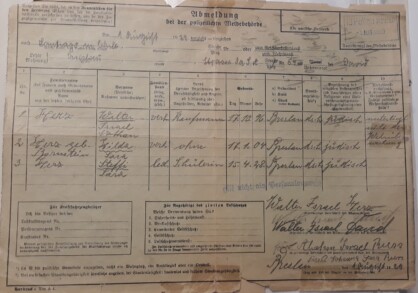
Deregistration of the Herz family from their house, September 1, 1939.
documentMore about objectFor Walter, Hilde and Steffi Herz, this compulsory police document of “deregistration” from their apartment at Straße der SA 54 (before 1933 Kaiser-Wilhelmstraße, now Powstańców Śląskich Street) marked the definitive closure of matters before emigration. The letter indicated the destination of their departure: Santiago de Chile. Approximately 13,500 Breslau Jews filed similar documents and dispersed […]
-

Table and chairs made by Albert Hadda, 1936.
objectMore about objectSome families fled with very little luggage, while others took all their belongings and items they had specially ordered for a life in exile. Among them was this table with chairs, the most practical of furniture and universal symbols of home. They were made by the architect and designer Albert Hadda in 1936 for the […]
-
Steffi Herz, her mother Hilde, Grandmother Gertrud Bornstein and great grandmother Henriette Lomniz, ca. 1939.
photographMore about objectOnly a year after leaving Germany, Hilde and Walter Herz managed to bring Hilde’s mother, Gertrud Bornstein, to Chile. In this photo taken in Breslau while the family was still together, Gertrud sits on the left, accompanied by her mother, daughter, and granddaughter. Walter’s mother, Olga Herz, also hoped to leave Germany, as she wrote […]
-
Letter of recommendation for Steffi Herz, July 31, 1939.
documentMore about objectThe destruction of the shoe store and the escalating Nazi terror motivated Walter and Hilde Herz to leave Germany for Chile where Hilde’s brother had settled. At the Jewish school that their daughter Steffi attended, they applied for a letter of recommendation to facilitate her enrollment in a school abroad. In the letter, the teacher […]
-
Fragment from a newspaper „Breslauer Jüdisches Gemeindeblatt”, 1938.
documentMore about object“Shoes for emigrants” – with this slogan, the Herz shoe store advertised its product range in the press in October 1938. It was aimed at Jews fleeing en masse from Germany to escape persecution, which did not spare the Herz family themselves. In the pogrom of November 9–10, 1938, the Nazis in Breslau vandalized about […]
-

Poems by Willy Cohn, 1910.
publicationMore about object“It was very painful for me to say goodbye to Daniel,” Willy Cohn noted in his journal on February 17, 1939. He was referring to Rudolf Daniel, his friend and former student, who was granted permission to immigrate to Mandatory Palestine, where he secured a position at a high school in Haifa and later at […]
-
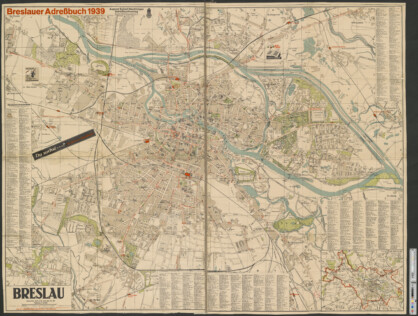
Breslau Pharus Plan 1939.
documentMore about objectSince its opening in 1872, the New Synagogue was often marked on Breslau city maps with an icon or a color reserved for prominent and recognizable landmarks. However, in the 1939 city plan, the New Synagogue is no longer present. All that was left of the building, demolished a year earlier by the Nazis during […]
-

In 1937 Willy Cohn and his wife Trudi spent a month in Mandatory Palestine in hopes of finding employment that would allow them to leave Germany permanently. This photo was taken during his stay at Kibbutz Givat Brenner where his son Ernst Abraham was already residing.
photographMore about objectThe number of Jews desperate to leave Germany after the November Pogrom surged, but they found few countries willing to take them in. In Mandatory Palestine, British quotas, issued every six months, limited the number of Jewish immigrants. Preference was given to young applicants who were fit for agricultural work. In 1935, fifteen-year-old Ernst Abraham […]
-
From the left Ruth, Tamara and Susanne Cohn, September 1939.
photographMore about objectThe number of Jews desperate to leave Germany after the November Pogrom surged, but they found few countries willing to take them in. In Mandatory Palestine, British quotas, issued every six months, limited the number of Jewish immigrants. Preference was given to young applicants who were fit for agricultural work. In 1935, fifteen-year-old Ernst Abraham […]
-
Heinrich Tischler’s self-portrait, 1937.
artworkMore about objectLiving under constant threat led to anxiety, frustration and depression. The artist Heinrich Tischler illustrated his emotional and spiritual crisis in this self-portrait, in which he depicted himself as a “living dead” spirit, clenching his fists in a gesture of helplessness. Due to Nazi persecution, Tischler, like many Jewish artists, had to abandon his work […]
-

Cohn siblings, 1935. From the left Ruth, Ernst Abraham and Susanne.
photographMore about objectThe number of Jews desperate to leave Germany after the November Pogrom surged, but they found few countries willing to take them in. In Mandatory Palestine, British quotas, issued every six months, limited the number of Jewish immigrants. Preference was given to young applicants who were fit for agricultural work. In 1935, fifteen-year-old Ernst Abraham […]
-

Erwin Zadik’s passport, 1937.
documentMore about objectThe Gestapo also persecuted Erwin Zadik, Ursula Beyer’s husband. After Erwin’s deportation to the Buchenwald concentration camp just two months after their wedding, Ursula purchased steamboat tickets for them to leave Germany as quickly as possible. Their destination was the British-American International Settlement in Shanghai, the only place in the world granting asylum to Jewish […]
-

Envelope of a letter written by Ursula Zadik from the prison in Breslau, January 5, 1939.
documentMore about objectThe Gestapo, the secret police, arrested Helga and Ursula Beyer in 1938 and held them in jail from where the sisters sent letters to their loved ones in envelopes like this one. The court acquitted Ursula, but sentenced Helga to three and a half years in prison for high treason as a communist who allegedly […]
-

Ursula and Helga Bayer with friends, Sudeten Mountains, 1937.
photographMore about objectIn Nazi Germany, political opposition was illegal, and cooperation with underground resistance groups required courage that few could muster. Sisters Ursula and Helga Beyer had that courage. One of the sisters’ tasks was to smuggle anti-Nazi newspapers from Czechoslovakia to Germany in ski poles under the guise of skiing expeditions in the Sudeten Mountains. In […]
-
Heinrich Tischler’s postcard from Buchenwald concentration camp, 1938.
documentMore about objectOn November 12, 1938, the planned tasks in Heinrich Tischler’s calendar abruptly end. On that day, as part of an operation to arrest Jewish men throughout Germany, the Nazis deported him to the Buchenwald concentration camp. “I’m doing well here, I don’t need anything,” he wrote on a postcard sent from the camp to his […]
-
Heinrich Tischler’s pocket calendar, 1938.
objectMore about objectOn November 12, 1938, the planned tasks in Heinrich Tischler’s calendar abruptly end. On that day, as part of an operation to arrest Jewish men throughout Germany, the Nazis deported him to the Buchenwald concentration camp. “I’m doing well here, I don’t need anything,” he wrote on a postcard sent from the camp to his […]
-

Halperts’ Chanukah, December 25, 1938.
photographMore about objectOn December 25, 1938, in the home that lawyer Otto Halpert shared with his wife Hertha and their three daughters at Eichendorffstraẞe 32/34 (Sokola Street), the eighth candle was lit on the traditional candelabrum known as the hanukkiah to mark the last day of the holiday of Hanukkah. One of the family members took this […]
-

New Synagogue in Breslau, nd.
photographMore about objectOn the night of November 9–10, 1938, Nazi paramilitaries, inspired by the authorities, carried out a pogrom against Jews throughout Germany, beating and killing people, vandalizing their houses and stores, and destroying synagogues. Hans Hermann Neustadt witnessed the destruction of the New Synagogue in Breslau. He kept this photograph of the Synagogue’s dome and towers […]
-

Albert Haddy’s application to the State Board of Fine Arts to revoke the exclusion decision, 1934.
documentMore about objectIn November 1934, Albert Hadda, like all Jewish architects in Germany, received a letter from the State Chamber of Fine Arts informing him that he was banned from practicing his profession. Albert decided to fight back: he submitted an appeal, but it was unsuccessful, and he was forced to find another source of income. Commissioned […]
-

Albert Hadda’s Arbeitbuch, 1936.
documentMore about objectIn November 1934, Albert Hadda, like all Jewish architects in Germany, received a letter from the State Chamber of Fine Arts informing him that he was banned from practicing his profession. Albert decided to fight back: he submitted an appeal, but it was unsuccessful, and he was forced to find another source of income. Commissioned […]
-
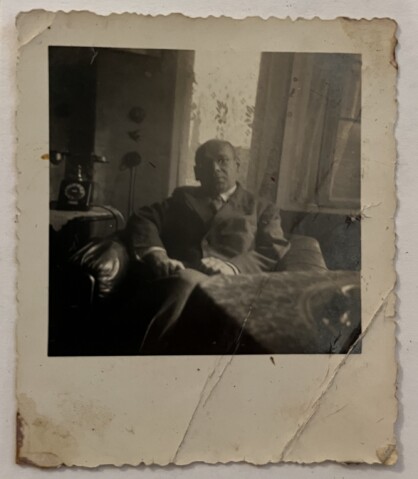
Willy Cohn in his study in 1934, in his home at 28 Opitz Street (Żelazna Street), Breslau, August 1934.
photographMore about object“Stephan, the school janitor, brought me a letter stating that I am on leave with immediate effect,” Willy Cohn, a historian and teacher at the Johannes-Gymnasium, noted in his journal on June 18, 1933. Already in the first months after coming to power, the Nazis used dismissals, forced leaves and early retirements against Jewish teachers, […]
-

Birthday letter in envelope to Steffi Herz in Chile from grandmother Olga in Breslau, March 15, 1940.
documentMore about objectOnly a year after leaving Germany, Hilde and Walter Herz managed to bring Hilde’s mother, Gertrud Bornstein, to Chile. In this photo taken in Breslau while the family was still together, Gertrud sits on the left, accompanied by her mother, daughter, and granddaughter. Walter’s mother, Olga Herz, also hoped to leave Germany, as she wrote […]
-

Ice skaters in Breslau, winter 1940/1941.
photographMore about objectThis photo of ice skaters on the frozen moat that runs along Wallstraße (Pawła Włodkowica Street) was taken in the winter of 1940-41 by Albert Hadda from the window of his apartment in Nikolai Stadtgraben 16 (Podwale Street). Was the photograph just a practice shot to test a new camera, or maybe an expression of […]
-

In the shadow of swastikas on the Baltic Sea, video, 1930s.
multimediaMore about objectIn the 1930s, the adopted family of pharmacologist Hermann Freund brought along an amateur camera on vacation, capturing shared moments on a Baltic beach. In the background of the cheerful shots, swastika pennants sometimes appear – the omnipresent symbols of the oppressive Nazi regime. Yet, despite difficulties, the majority of the Jews tried to live […]