
BECOMING A BRESLAUER
In the middle of the 18th c., after a long absence resulting from medieval expulsions, Jews were once again allowed to settle permanently in the city. Soon, the professional and sometimes personal paths of Jewish and non-Jewish residents of Breslau began to intertwine. Although their civil rights were granted gradually, they became an increasingly active group in the city’s economic and public life. Mainly the wealthiest of Jews, in particular merchants and entrepreneurs, benefitted from these changes. Over time, further opportunities opened up for Jews when they were allowed to study at the local university and assume public office.
-
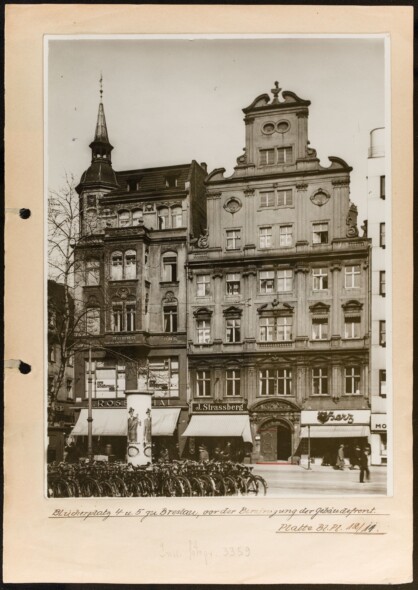
Blücherplatz 4 u. 5 zu Breslau, vor der Bereinigung der Gebäudefront.
photographMore about objectJews were residents of the Oppenheim House since the early 19th c. In 1810, banker Heymann Oppenheim purchased the building and moved in with his family. The Oppenheims were among the so-called privileged Jews, who had a permit for permanent settlement in the city. From 1902 to 1942, the building belonged to the Jewish community, […]
-

Four generations of women from Herz family: Steffi Herz, her mother Hilde, grandmother Gertrud Bornstein and great grandmother Henriette Lomnitz, 1929.
photographMore about objectFrom 1894, for over 40 years, the Herz family ran a shoe store in the Oppenheim House at Blücherplatz 4 (Salt Square), where we are currently standing. This photo, with the now non-existent south wing of the Royal Palace at Schloßplatz (Wolności Square) visible in the background, depicts the female representatives of four generations of […]
-

H. Fischer, etching with the view of the University in Breslau, after 1904.
artworkMore about objectThe apartment of doctor Walther Freund was decorated with a bronze figure of a fencer – a miniature of the sculpture from the fountain found in the front of the University of Breslau, dating back to 1904. Perhaps the iconic figure reminded Walther of his days as a student: both he and his father Wilhelm […]
-

Photo of the interior of the house by Vogelweide 187 (19 Mikołaja Kopernika Street), 1933.
photographMore about objectThe apartment of doctor Walther Freund was decorated with a bronze figure of a fencer – a miniature of the sculpture from the fountain found in the front of the University of Breslau, dating back to 1904. Perhaps the iconic figure reminded Walther of his days as a student: both he and his father Wilhelm […]
-
Diploma on the occasion of Wilhelm Salomon Freund’s retirement from the position of the Chairman of Council, December 29th, 1914.
documentMore about objectThe end of Wilhelm Salomon Freund’s municipal duties coincided with the beginning of World War I. Influenced by his conciliatory attitude, the German Progressive Party, of which he was a member, refrained from criticizing Kaiser Wilhelm II at the time. A year before his death, Freund received this diploma, decorated with a depiction of the […]
-
Diploma of honorary citizenship for Wilhelm Salomon Freund, the Secret Counselor, awarded to him by the city magistrate on January 1st, 1901.
documentMore about object“Arbeit ist des Bürgers Zierde” – “Work’s the burgher’s decoration”. This motto, taken from Friedrich Schiller’s poem, is featured on the “Ehrenbürgerurkunde”, or Certificate of Honorary Citizenship awarded to Wilhelm Salomon Freund in recognition of his decades of service as a longtime member and chairman of the Breslau City Council its. Freund was the first […]
-

Portrait photograph of Wilhelm Salomon Freund as a young man, 1860s.
photographMore about objectWilhelm Salomon Freund was a lawyer and president of the Breslau Bar Association. A distinguished graduate of the University of Breslau who defended his doctoral thesis at the age of twenty, he received an honorary doctorate from the law faculty in 1901. He is remembered by his family just like he is portrayed in this […]
-

Photo of the interior of the house by Vogelweide 187 (19 Mikołaja Kopernika Street), 1933.
photographMore about objectBabette Silberstein’s portrait adorned successive residences of her descendants in Breslau, which included the home of her daughter Lina Immerwahr, née Silberstein, located at Ring 19 (Market Square 19). In the early 20th c., it hung in the home of her granddaughter Clara Freund, née Immerwahr, at Schweidnitzer Stadtgraben 20 (Podwale Street). By 1930, it […]
-

Portrait of Babette Silberstein, first half of the 19th century.
artworkMore about objectBreslau, the largest city and economic center of Silesia, attracted newcomers from smaller towns. Babette Silberstein, née Friedländer, arrived in Breslau with her husband Philipp from the town of Brieg (today Brzeg) around 1814. They settled at Wallstraße 13 (now Pawła Włodkowica Street), near to where the White Stork Synagogue, co-founded by Philipp, would soon […]